AI Developer Briefing: GPT-6 Cyber, Images 2.6, Claude Agents and Cloudflare Audits
This week’s AI developer changes touch security research, image production and the overhead of running agents. Here are **four practical sections**, covering November announcements and one clearly dated tool worth revisiting.
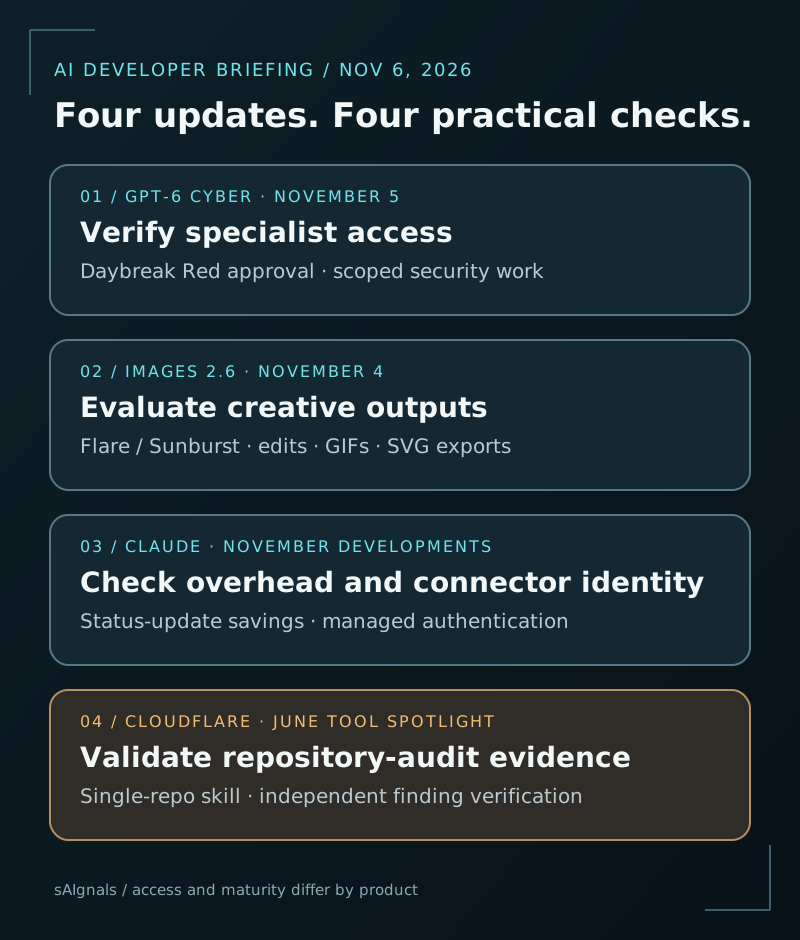
1. GPT-6 Cyber: specialist access for authorized security work
OpenAI published its [GPT-6 Cyber system card on November 5](https://deploymentsafety.openai.com/gpt-6-cyber). The model is a cyber-specialized GPT-6 Astra variant intended for authorized vulnerability research and related security work. OpenAI classifies its cybersecurity capability as **Critical** under its Preparedness Framework; that is the company’s capability designation, not a claim that every task succeeds.
The [model documentation](https://developers.openai.com/api/docs/models/gpt-6-cyber) requires **Daybreak Red access and approval**. Standard short-context API rates are **$20 per million input tokens and $100 per million output tokens**. Cached input and cache writes have separate rates. These prices do not grant eligibility.
For a security team, the next step is to confirm approval and the required project configuration before an isolated, explicitly scoped evaluation. Daybreak Blue approval does not automatically grant Red access, and API safeguards differ from Codex’s product controls. [Source: cybersecurity access and safeguards](https://developers.openai.com/api/docs/guides/safety-checks/cybersecurity)
2. Images 2.6: faster iteration, GIFs and SVG output
OpenAI [introduced Images 2.6 on November 4](https://openai.com/index/introducing-images-2-6/) in ChatGPT, Codex and the API. **Flare** targets fast iteration; **Sunburst** targets more detailed work and consistency across edits. OpenAI claims generation is **50% faster than before**; sAIgnals has not independently reproduced that figure.
The release adds GIF creation, markup-guided API edits and SVG exports. A new complexity setting controls planning effort separately from visual quality. A practical trial is to create a product visual, mark one localized correction, then produce a loop or export for the next production step. Verify brand details and exported artifacts before using them.
Both [Flare](https://developers.openai.com/api/docs/models/gpt-image-2.6-flare) and [Sunburst](https://developers.openai.com/api/docs/models/gpt-image-2.6-sunburst) list **$5 per million text-input tokens, $8 per million image-input tokens and $30 per million image-output tokens**, with lower cached-input rates. Those are token prices, not a fixed all-in cost per image; prompts, references, output settings and retries affect the bill. Product subscription access follows its own limits.
3. Claude: cheaper background status, simpler connector setup
Anthropic’s [November 4 developer announcement](https://x.com/ClaudeDevs/status/2118063143167693011) explains a narrow but useful optimization: background subagents update their status every 30 seconds. Those updates previously re-read the conversation; **Haiku 5.5 now writes them from short notes**, making each update **about 99% cheaper**, according to Anthropic. This does **not** mean the entire agent job uses 99% less quota or costs 99% less.
Connector authentication is also becoming easier. [Enterprise-managed auth](https://support.claude.com/en/articles/15537633-auto-connect-your-organization-s-apps-to-claude) lets Team and Enterprise administrators authorize compatible connectors centrally. **IdP-managed auth is GA; Claude-issued auth is beta**. The latter identifies users through Claude without requiring an external IdP or SSO. Admin setup, supported connectors and service permissions still apply.
[WorkOS announced support on November 3](https://workos.com/changelog/workos-mcp-auth-supports-claude-auto-connect), with its Claude auto-connect integration in early access. For an internal tool, the useful evaluation is whether employees can reach the intended service with the right identity and permissions, including after access is revoked.
4. Tool spotlight: Cloudflare’s security-audit skill is older—and useful to inspect
Cloudflare released the initial skill alongside [its June 18, 2026 vulnerability-harness post](https://blog.cloudflare.com/build-your-own-vulnerability-harness/). This is **an older project spotlight, not a launch this week**.
The MIT-licensed [security-audit skill](https://github.com/cloudflare/security-audit-skill) describes reconnaissance, coverage-led investigation, candidate validation, structured output and independent verification. It is the single-repository starting point that preceded Cloudflare’s larger fleet system. The harness’s reported findings must not be treated as results a user gets simply by installing this skill. Agent inference and the execution environment still have their own costs.
For a first review, select a repository you own, define the trust boundaries and ask for source evidence and a safe reproduction for each candidate. Treat the output as material to investigate and verify, rather than a certificate that the application is secure.
Your next step
Sources
- OpenAI: GPT-6 Cyber system card, November 5
- OpenAI API: GPT-6 Cyber rates and eligibility
- OpenAI API: Daybreak approval and safeguards
- OpenAI: Images 2.6 release, November 4
- OpenAI API: GPT-Image-2.6 Flare pricing
- OpenAI API: GPT-Image-2.6 Sunburst pricing
- ClaudeDevs: background status-update optimization, November 4
- Anthropic: enterprise-managed connector authentication
- WorkOS: Claude auto-connect early access, November 3
- Cloudflare: security-audit skill README and MIT license
- Cloudflare: original skill release, June 18