Anthropic Tells Claude Code to Stop Recreating Existing Games. What About REA?
Anthropic is drawing a boundary around one of AI coding's most contentious uses: recreating somebody else's game. In an October 30 update, **Game Developer reported confirmation from an Anthropic spokesperson**, who pointed to a statement by Addy Osmani about new instructions for Claude Code with Opus 5.5. [Source: the report and company response](https://www.gamedeveloper.com/programming/anthropic-appears-to-have-ordered-ai-tool-claude-to-stop-remaking-video-games)
The interesting question for developers is what this changes about their workflow. A tool may still be able to inspect an application while the assistant using it declines a particular reconstruction request. Those are different layers of the system.
The confirmed boundary
Osmani's [statement](https://x.com/addyosmani/status/2116213240363729013), reproduced in the report, describes steering the assistant away from recreating another person's specific game. Original games, genre-based projects, and work using the developer's own designs and assets are intended to remain supported. He also invited reports of refusals affecting users' own work. This is a statement of intended behavior, not a demonstration that every request is classified correctly.
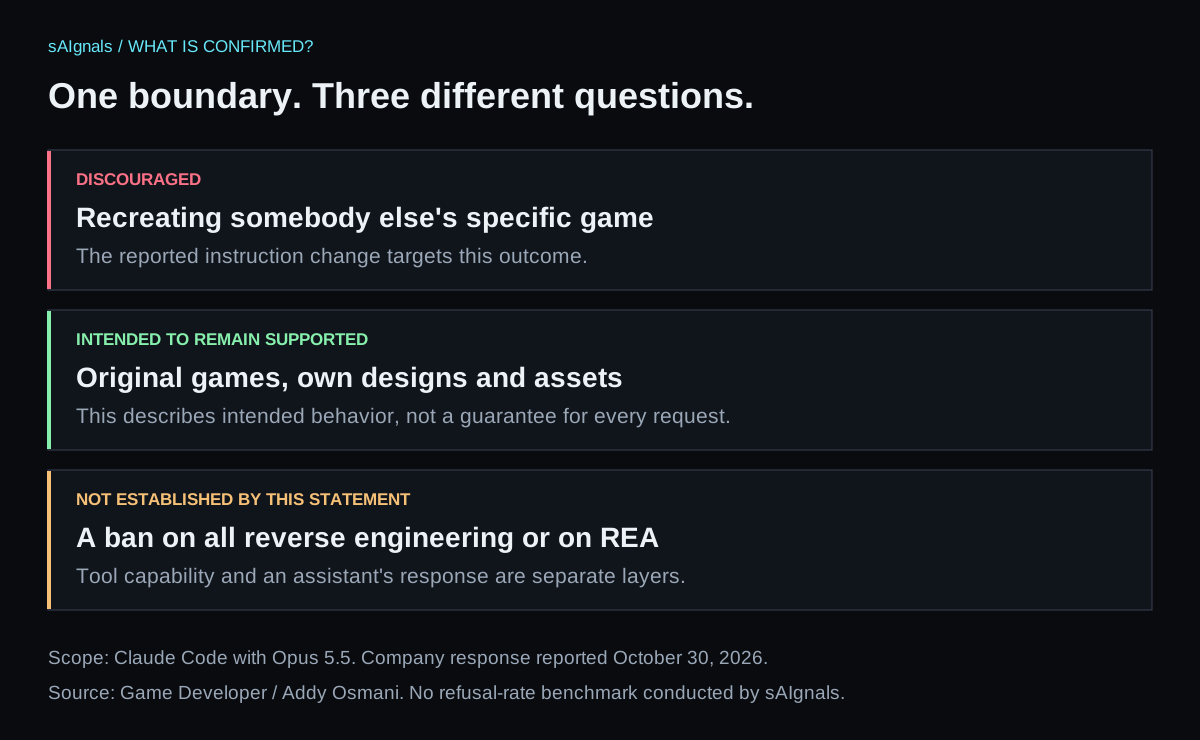
We have not independently tested refusal rates or the effect across models and interfaces. The confirmed statement concerns Claude Code with Opus 5.5; it does not establish identical behavior for every Claude deployment.
Does this mean REA has stopped working?
That conclusion does not follow from the announcement. [REA's project documentation](https://github.com/morluto/rea) describes an analysis layer that connects an agent to inspection tools for native binaries, JavaScript/Electron applications, .NET assemblies, and websites. Its outputs include findings and supporting evidence.
An analysis tool, an assistant's decision to use it, and the requested deliverable are separate things. Consider three different requests:
- Explain an observed input/output behavior and record the evidence.
- Investigate a defect in software your team maintains.
- Reconstruct a particular existing game as a replacement product.
These examples illustrate different engineering goals; they are not test results or guarantees that a provider will accept them. A refusal on one request does not, by itself, show that the inspection tool is broken. Equally, successful tool execution does not guarantee that the assistant will complete the next step.
The bigger issue: dependencies now include assistant behavior
Our editorial reading is that agent-based workflows need a more explicit dependency map. A team can pin an analysis tool's version and retain its inputs, yet still depend on the behavior of the assistant orchestrating it. A changed response can interrupt that workflow without any change to the target program.
For a reproducible investigation, record the task, tool and model versions, available inputs, and the step that failed. Distinguish a missing analysis provider, a tool execution error, weak evidence, and an assistant refusal. That makes a useful bug report and avoids treating every failure as the same problem.
For your own work, describe the actual target and intended output accurately. Keep original assets, observations, and test cases organized. If a refusal appears to misclassify your project, report that case rather than disguising the request. None of these practices promises approval or establishes rights to another project's material.
What we will watch next
The unanswered questions are practical: how often original projects are incorrectly rejected, whether behavior differs between supported interfaces, and whether users receive a clear explanation when a task is declined. Answering them requires reproducible examples rather than a collection of screenshots with different prompts and settings.
Our [REA setup and investigation guide](/articles/how-to-use-rea-reverse-engineering-claude-code-codex) focuses on a bounded inspection and verification workflow. Read it alongside this update: connecting a tool and obtaining evidence remains a different question from whether an assistant will produce a requested recreation.