GitHub Copilot Fusion Goes GA: Model Routing, Review Loops and a Local-Model Preview
GitHub [announced Copilot Fusion general availability on October 28](https://github.blog/changelog/2026-10-28-route-and-orchestrate-models-with-github-copilot-fusion/), bringing automated model selection and orchestration into everyday coding. Fusion builds on HydraFusion and earlier auto selection. The new GA milestone is the story here, rather than a fresh launch of the underlying preview.
Select Fusion in the model picker and choose **Standard, High or Max**. The GA announcement lists VS Code, Copilot CLI, the Copilot app and JetBrains, across Copilot plans. Actual model access remains subject to your subscription and organization policies. [Source: release announcement](https://github.blog/changelog/2026-10-28-route-and-orchestrate-models-with-github-copilot-fusion/)
One task, several possible execution paths
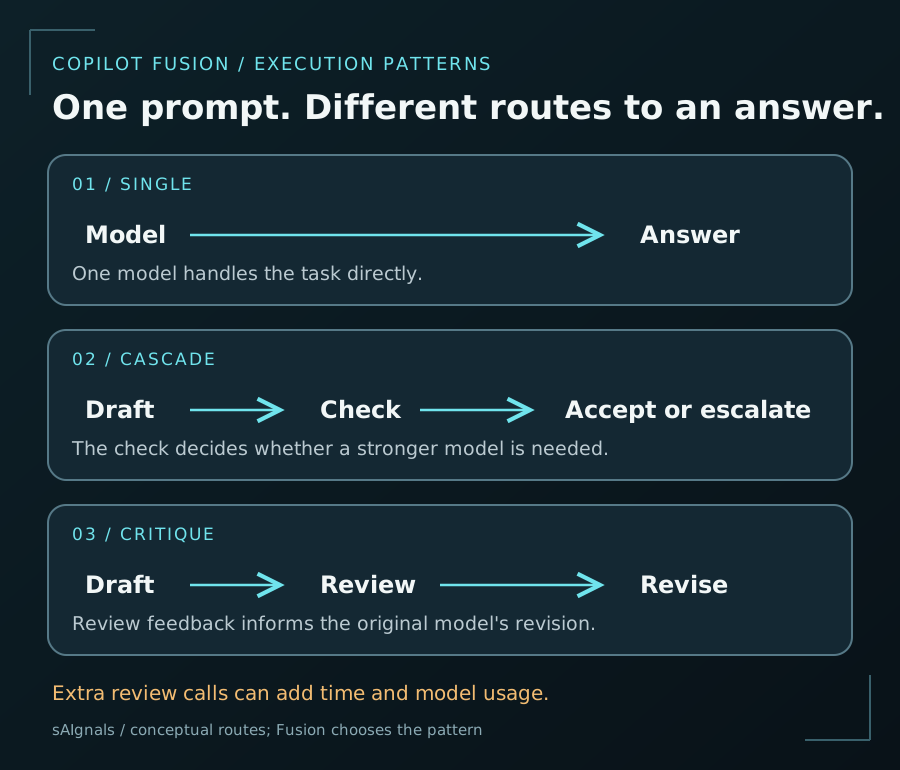
Fusion can complete a prompt with one model, check an initial draft and escalate if needed, or use reviewers before revising the answer. These are its **Single, Cascade and Critique** patterns. The system chooses the pattern; an effort level expresses the tradeoff you want. [Source: execution model](https://docs.github.com/en/copilot/concepts/models/copilot-fusion)
Standard targets everyday tasks; High adds orchestration for more demanding work; Max prioritizes deeper analysis. These are useful settings to test against your own workload, rather than guarantees that a particular task will succeed. Importantly, GitHub documents that **discarding a draft does not automatically revert edits it already made in your workspace**. Inspect the diff before committing. [Source: effort levels and limitations](https://docs.github.com/en/copilot/concepts/models/copilot-fusion)
What does it cost?
Fusion has no separate orchestration fee: billing follows the models it actually uses. GitHub's documentation lists a **30% discount on model costs for paid Copilot plans through November 30, 2026**, checked November 3. High and Max can make additional calls, so the discount alone does not establish a cheaper completed task. [Source: Fusion billing](https://docs.github.com/en/copilot/concepts/models/copilot-fusion)
Copilot measures input, output and cached tokens using model-specific rates, converted into AI credits; **one AI credit equals $0.01 USD**. Check your included allowance and spending budget alongside the model rates. There is no universal flat price for a Fusion task. [Source: pricing and usage accounting](https://docs.github.com/en/copilot/reference/copilot-billing/models-and-pricing)
Local routing is a separate preview
GitHub also announced an **opt-in experimental preview** for choosing between supported local and cloud models. The managed Windows experience supports MAI Code 1.1 Flash. Copilot CLI can also use supported manually configured models on Windows, macOS and Linux, including Qwen3.8 Flash Next, subject to hardware and setup requirements. [Source: local-routing announcement](https://github.blog/changelog/2026-10-28-github-copilot-fusion-now-supports-selection-of-local-models/)
Support differs by client: the Copilot app's intelligent local routing currently uses managed Windows ML models. Connecting a model through BYOK does not automatically make it eligible for routing. Most importantly, **routing decisions still happen in the cloud**. Local inference is not an offline-session guarantee. [Source: preview scope and limitations](https://github.blog/changelog/2026-10-28-github-copilot-fusion-now-supports-selection-of-local-models/)
A practical trial
Our suggested trial is to compare Standard and a higher effort level on a small set of previously solved issues. Keep the repository state and acceptance tests fixed; record passing changes, reviewer corrections, elapsed time and actual usage. For a local-model trial, first confirm eligibility and data-handling requirements. These are evaluation suggestions, not results from a sAIgnals benchmark.