Kimi K3.1 Pro: 2.8T Parameters, 1M Context and Lower API Prices
Moonshot AI [introduced Kimi K3.1 Pro on October 23](https://x.com/Kimi_Moonshot/status/2113680701770068067), specifying **2.8 trillion total parameters and 104 billion active parameters** in a mixture-of-experts model. The headline size describes the entire model; the active count describes the subset used during inference. Its **1,048,576-token context** is retained from K3. [Sources: official launch](https://x.com/Kimi_Moonshot/status/2113680701770068067); [API specifications](https://platform.kimi.ai/docs/pricing/chat)
What changes from K3?
Moonshot describes Pro as a post-trained K3 with substantially more post-training compute. The release targets coding, 3D creation and agent workflows. The company reports **65.7% on Terminal-Bench 4.0**, with its footnotes specifying the Claude Code harness. That is a vendor evaluation; sAIgnals has not reproduced it. [Source: release and evaluation notes](https://www.kimi.com/en/blog/kimi-k3-1-pro)
A cheaper standard API, plus a premium speed option
The [international API price sheet](https://platform.kimi.ai/docs/pricing/chat) lists standard Pro at **$2 per million input tokens and $10 per million output tokens**, versus K3's **$3 and $15**. Both base rates are one-third lower. Highspeed costs **$4 input and $20 output**; Moonshot claims 2–3× standard Pro's speed. These are international USD rates before tax, checked October 28. [Sources: pricing](https://platform.kimi.ai/docs/pricing/chat); [Highspeed announcement](https://www.kimi.com/en/blog/kimi-k3-1-pro)
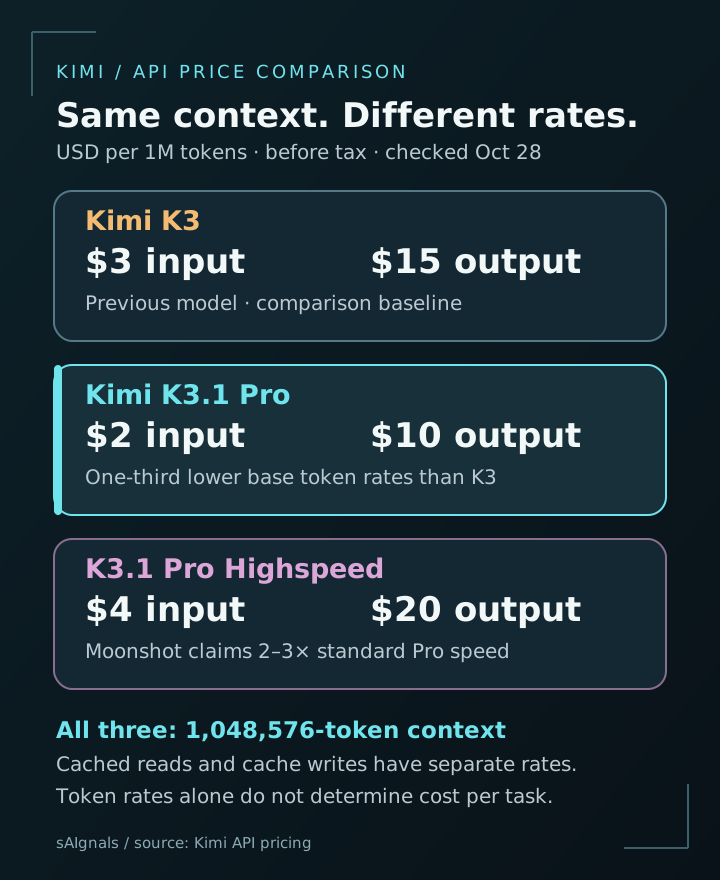
Caching has separate charges. Standard Pro and Highspeed both list **$0.20 per million cached-input tokens**. Standard Pro cache writes cost **$2 for a five-minute TTL or $4 for one hour**; Highspeed writes cost **$4 or $8** respectively. API billing is separate from product subscriptions. [Source: billing documentation](https://platform.kimi.ai/docs/pricing/chat)
For an illustrative workload across several requests totaling one million ordinary input tokens and 100,000 output tokens, base token arithmetic gives **$3 for standard Pro**, **$4.50 for K3** and **$6 for Highspeed**. This example excludes caching, external tools and tax. Actual agents may generate different amounts of reasoning and repeat model calls, so equal token counts do not imply equal work completed.
What developers should configure and measure
The API exposes `kimi-k3.1-pro` and `kimi-k3.1-pro-highspeed`. Thinking is always enabled. The top-level `reasoning_effort` setting accepts **low, high or max**, with **max as the default**. The guide covers streaming, visual input and tool calling. [Source: API quickstart](https://platform.kimi.ai/docs/guide/kimi-k3-1-pro-quickstart)
Reasoning content counts toward token usage; retained thinking also occupies context and is billed accordingly. Compare effort settings on the same tasks and inspect billed usage, latency and corrections. A lower price per token becomes useful when the full workflow still produces the result you need. [Source: thinking and token-billing guide](https://platform.kimi.ai/docs/guide/use-thinking-models)
A practical coding trial is to select a small set of previously solved issues, provide the same repository state and acceptance tests, then compare both Pro variants with the current model. Track passing changes, review effort, retries and total cost. For 3D work, validate geometry and exported artifacts rather than judging only a preview image.
API access now; downloadable weights are still promised
Moonshot lists availability across Kimi's apps, Kimi Work, Kimi Code and the API. In Kimi Code, use `/model` to select Pro. The company promises **full model weights by November 4, 2026**. As of this news publication on October 28, treat that as an upcoming commitment and verify the files and license before planning a self-hosted deployment. [Source: availability announcement](https://www.kimi.com/en/blog/kimi-k3-1-pro)