OpenAI Releases GPT-6.1 Terra for Visual Reasoning and Computer Use
OpenAI [released GPT-6.1 Terra on October 26](https://developers.openai.com/api/docs/changelog). The new API model, `gpt-6.1-terra`, is positioned for **visual reasoning, precise computer use and clear writing**. That is a useful distinction from a general “best coding model” claim: Terra is a candidate for focused screen and image workflows, not a proven replacement for every agent or engineering task. [Source: OpenAI model page](https://developers.openai.com/api/docs/models/gpt-6.1-terra)
What can developers use it for?
OpenAI suggests matching product photos to catalog entries, interpreting technical drawings, acting on application screens and drafting or revising text. Its [model-selection guide](https://developers.openai.com/api/docs/guides/model-selection) also points to scoped code fixes. In practice, a team might test it on a screenshot-based UI check, a small issue with an expected patch and regression test, or a document-review flow where the important output is a concise decision. These are suggested evaluations, **not independently verified performance results**. [Sources: model page](https://developers.openai.com/api/docs/models/gpt-6.1-terra); [model-selection guide](https://developers.openai.com/api/docs/guides/model-selection)
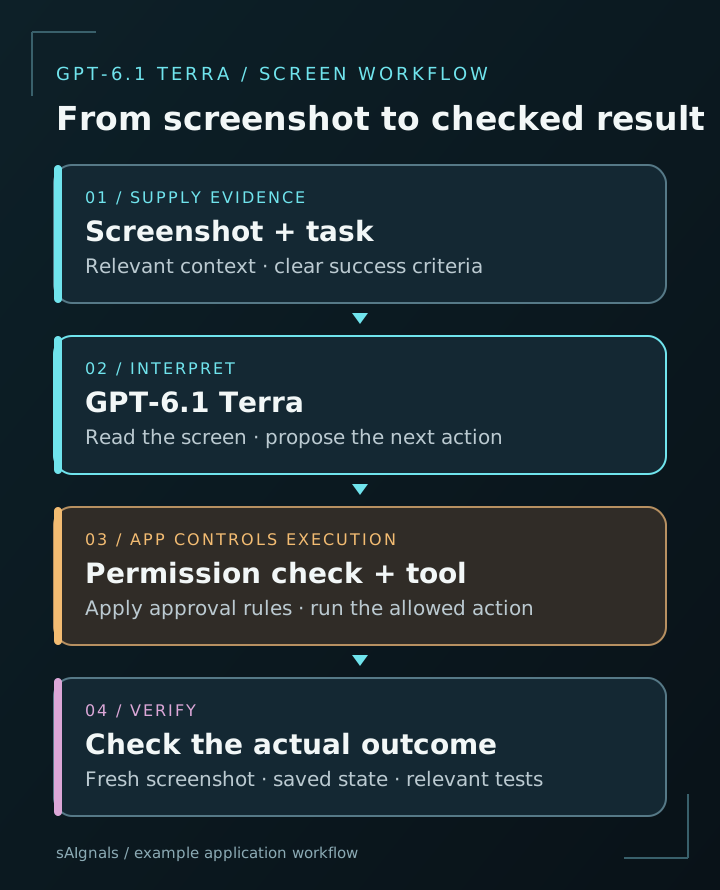
The model accepts **text and image input** and produces text. It supports structured outputs. OpenAI lists both Responses and Chat Completions, but says **tool calling requires the Responses API**; computer use is among the tools listed for the model on that route. It does not list native audio or video support. Developers should still set tool permissions, review consequential actions and verify the final state of any screen-based task. [Source: OpenAI model page](https://developers.openai.com/api/docs/models/gpt-6.1-terra)
What does it cost?
The [published Standard text rates](https://developers.openai.com/api/docs/models/gpt-6.1-terra) are **$1 per million uncached input tokens**, **$0.05 per million cached input tokens**, **$1.25 per million tokens written to a 30-minute cache**, and **$5 per million output tokens**. A 12-hour cache write is **$2.50 per million tokens**. These are distinct rates: a cache write is not the same as a cached read. Tool-specific fees may apply, and regional processing adds a premium where available. [Source: OpenAI model page](https://developers.openai.com/api/docs/models/gpt-6.1-terra)
The context window is **1,050,000 tokens**, but requests exceeding **272,000 input tokens** are charged at higher long-context rates for the *entire request*: 2× input and cache rates and 1.5× output. A large context window therefore does not make indiscriminate context stuffing economical. Start with the smallest evidence set that lets the task succeed, then measure quality and billed usage. [Source: OpenAI model page](https://developers.openai.com/api/docs/models/gpt-6.1-terra)
Should teams switch?
OpenAI describes Terra as fast and efficient, but the announcement does not provide a benchmark that sAIgnals has reproduced. A sensible comparison is task-specific: run Terra and the current model on the **same screenshots, prompts, reasoning effort and tool boundaries**, then measure accuracy, latency, human corrections and cost per completed task. For a complex coding project, compare it against a model aimed at deeper multi-step work rather than choosing on token price alone. [Sources: model page](https://developers.openai.com/api/docs/models/gpt-6.1-terra); [OpenAI model-selection guide](https://developers.openai.com/api/docs/guides/model-selection)
**Bottom line:** GPT-6.1 Terra widens the API choice for visual and screen-based workflows at its published $1/$5 input/output rate. Its practical value depends on whether it completes *your* bounded task accurately and safely, not on the model-family name.