TanStack AI 1.0 Is Here: Use Cases, Strengths and the Experimental Harness
TanStack [released TanStack AI 1.0 on October 23](https://tanstack.com/blog/tanstack-ai-1-0). It is a TypeScript toolkit for adding AI features to an application—not a new language model or a hosted inference service. The **core APIs are now stable**; the newly announced **agent harness is experimental**. That distinction matters if you are deciding what to ship to production.
What does TanStack AI do?
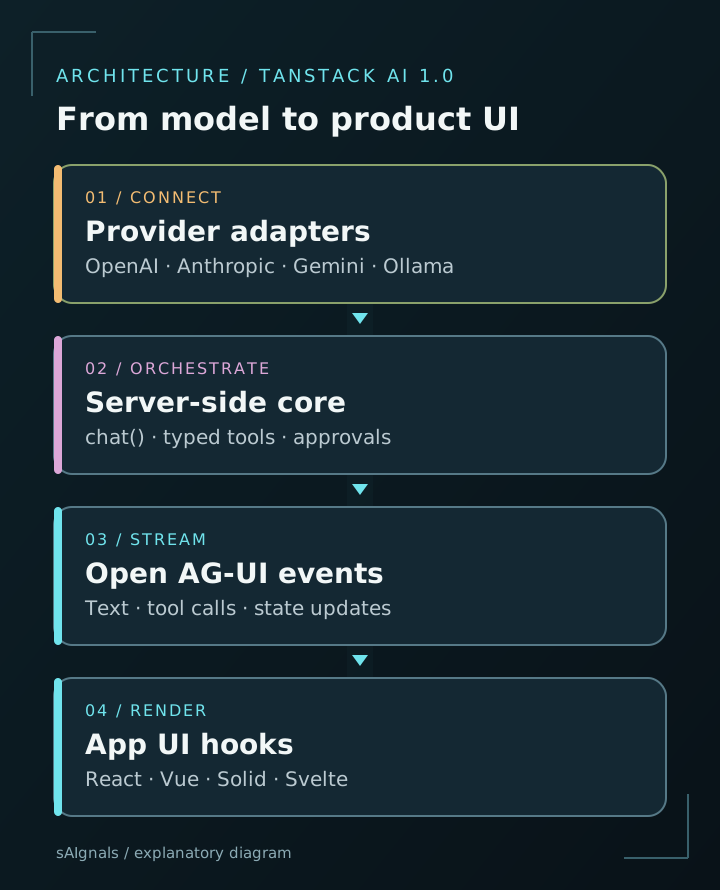
The [overview](https://tanstack.com/ai/latest/docs/getting-started/overview) describes a server-side adapter that calls a model provider and a client hook that reads streamed responses. The SDK covers streaming chat, tool calling, and media generation. TanStack says 1.0 includes 23 provider adapters and UI integrations spanning React, Vue, Solid, Svelte and other frameworks. That lets a TypeScript app keep its own UI and swap model adapters without rewriting the whole chat flow; adapter support and model-specific capabilities still need checking. [Source: release announcement](https://tanstack.com/blog/tanstack-ai-1-0)
Three concrete use cases:
1. **A support or documentation assistant inside an existing app.** Stream answers into a custom UI, add typed tools for permitted account or knowledge-base lookups, and require approval before sensitive tool actions. [Source: overview and tools](https://tanstack.com/ai/latest/docs/getting-started/overview)
2. **A multi-provider workflow.** Keep the app’s chat and tool structure while evaluating another provider adapter for a specific task, such as lower-latency summaries or image generation. That is an integration option, not a promise that every model behaves identically. [Source: overview](https://tanstack.com/ai/latest/docs/getting-started/overview)
3. **A long response that survives a dropped connection.** TanStack’s [resumable streams](https://tanstack.com/ai/latest/docs/resumable-streams/overview) log chunks for replay on reconnect without another model call. The quickstart’s in-memory adapter is for development or a single process; production deployments need a shared durability backend. Conversation persistence is a separate concern.
Where might it be stronger than Vercel AI SDK?
Both are open-source TypeScript toolkits that stream chat and call tools across providers. According to [TanStack’s own comparison](https://tanstack.com/ai/latest/docs/comparison/vercel-ai-sdk), its differentiators include the open **AG-UI** wire protocol, per-model TypeScript option narrowing, one tool schema that can run server-side or client-side, and its composable durability path. These can be real advantages when an app must interoperate with AG-UI agents, own its UI, or resume streams across network drops. They are **architectural differences documented by TanStack, not independent evidence that TanStack is faster, cheaper, or more accurate**.
There is a clear counterexample: if your existing frontend and backend already use the Vercel AI SDK UI Message Stream protocol, TanStack says its SDK **does not read or write that protocol**. Migrating simply for a new release could add cost without a product benefit. [Source: TanStack comparison](https://tanstack.com/ai/latest/docs/comparison/vercel-ai-sdk)
What is stable—and what is not?
TanStack says the 1.0 core is production-ready, but `@tanstack/ai-harness` and related harness entry points remain experimental 0.x APIs and may change in minor releases. The harness aims to keep an agent session alive across messages and deployment boundaries, including coding-agent workflows. Treat it as a prototype candidate, not part of the 1.0 stability promise. [Source: launch post](https://tanstack.com/blog/tanstack-ai-1-0)
For teams already on 0.x, upgrade the stable `@tanstack/ai*` packages **together**: a 1.0 client requires a 1.0 server. TanStack also removed deprecated 0.x APIs and documents a codemod plus migration checks for saved conversations. [Source: release and upgrade notes](https://tanstack.com/blog/tanstack-ai-1-0)
**Bottom line:** TanStack AI 1.0 is most interesting when you want a typed, framework-flexible AI layer and control of the wire protocol. If an existing AI SDK app already works well, compare migration effort against the specific capability you need before switching.