Three Trending AI Repositories That Improve the Work Around the Model
A coding agent can produce a working feature and still leave you with three expensive problems: the interface feels unrelated to the rest of the product, the next session forgets why a decision was made, and a confident completion message arrives before anyone has checked the result.
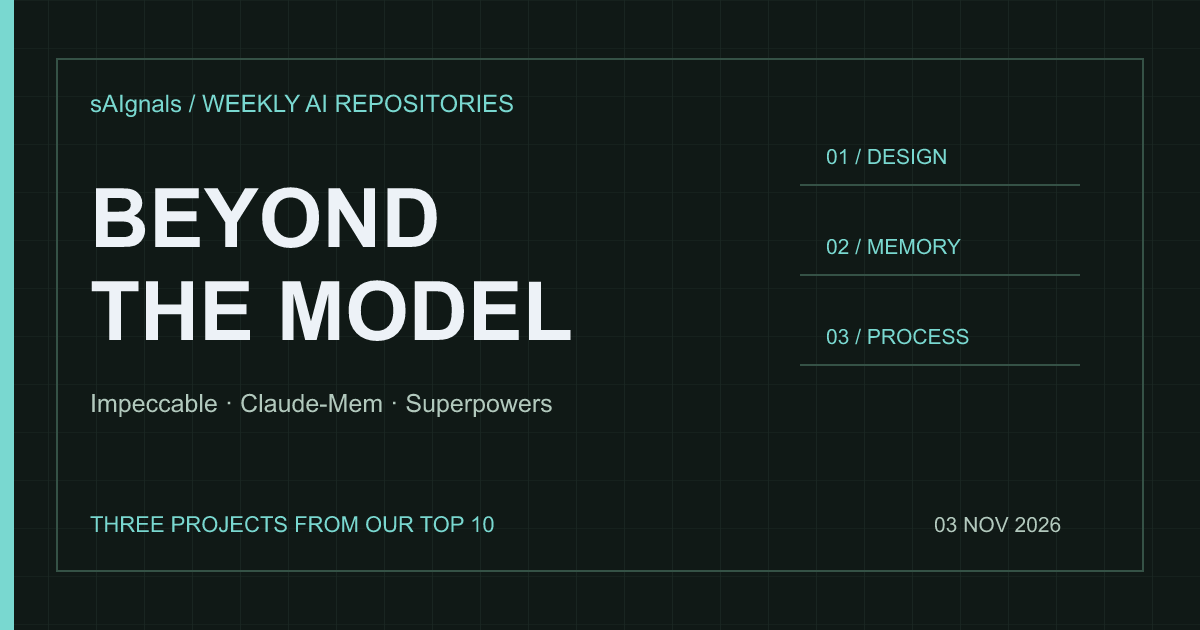
This week's repository picks address those different failure modes. Impeccable gives interface work a more specific design vocabulary. Claude-Mem preserves and retrieves context across sessions. Superpowers organizes development around explicit decisions, implementation steps, and verification. Their common theme is the engineering around a model: what it sees, how it works, and how its output is judged.
This is the first edition of our Tuesday AI repository review. We selected three projects from the top ten in the sAIgnals AI Trending sample, captured on November 3, 2026 at 08:46 UTC. This is a documentation-based analysis, not a hands-on benchmark: we inspected primary documentation and pinned repository revisions, but did not install these projects or measure their effects. The evaluation exercises below are proposed tests, not reported results.
What made this week's shortlist
| Repository | Position in our sample | New stars this week | Why we selected it |
|---|---|---|---|
| pbakaus/impeccable | 1 | 11,754 | A concrete workflow for steering and reviewing interface design |
| thedotmack/claude-mem | 3 | 7,255 | A useful case study in persistent agent context and its operational cost |
| obra/superpowers | 5 | 5,956 | An explicit development process that can be inspected rather than taken on trust |
The counts come from our captured weekly GitHub Trending sample. They are neither total stars nor a ranking of every AI project on GitHub. They measure attention, not adoption, security, or output quality. We chose distinct use cases rather than mechanically taking the first three entries. None of the selected repositories had a previous substantive article in our coverage register.
The useful question is not which project has the biggest number. It is which recurring failure in your workflow you can describe precisely enough to test a remedy.
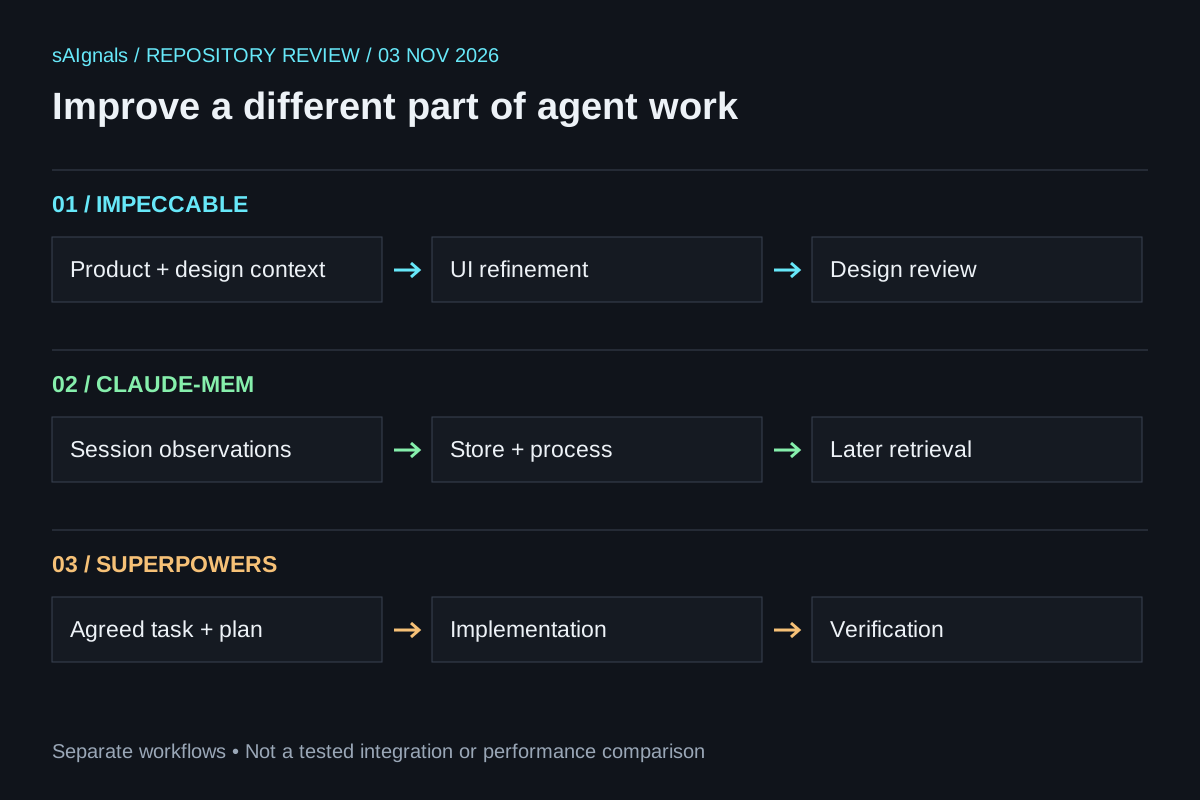
1. Impeccable: give interface feedback a specific target
Impeccable is useful when the application works but the interface keeps converging on generic layouts. Its repository packages agent guidance and design tooling, including commands for critique, audit, refinement, and hardening. The documented installation entry point is npx impeccable install; reload the coding tool afterward. The project uses Apache-2.0 licensing. Node is needed for the npm entry point, while the skill uses a separate engine binary. Installing the package is different from proving that every integration or hook is active.
The more interesting part is the distinction between product intent and visual rules. The context documentation assigns audience, goals, and constraints to PRODUCT.md; the separate document operation records the visual system in DESIGN.md. That prevents a reasonable product statement such as “people use this screen on a phone” from being mistaken for a complete specification of spacing, components, or typography.
For an established application, our recommendation is to begin with one troublesome surface. Take a newsletter form that uses the brand colors but has a much larger heading and different spacing from neighboring pages. First identify which existing pages represent the intended design. Then ask for a critique of the form against those references. Review the diagnosis before accepting changes. This is a bounded task with an observable outcome: the form should fit its surroundings while preserving labels, keyboard operation, and submission behavior.
A useful evaluation brief would be:
Review the newsletter form against our existing article and news pages.
Identify mismatches in hierarchy, spacing, typography, and input states.
Keep the established components and explain each proposed change.
After implementation, inspect desktop and mobile and exercise the form.
This is our suggested brief, not a quotation from the project. It forces a comparison with a product-specific reference instead of asking the agent to invent a new aesthetic.
What its detector can and cannot establish
The detector guide distinguishes scans of source files from scans of rendered URLs. A code scan can identify patterns in markup and styles; a browser scan can inspect properties that depend on actual rendering. The documented commands include npx impeccable detect src/ and a URL-targeted scan of a local development server. This distinction matters: a source-only result is not evidence that text fits a real viewport.
A clean scan also does not establish that users understand the page. Automated findings should feed a review, not replace one. We would compare screenshots, keyboard paths, and error states before and after a change, then separately measure whether the page helps users complete its task. A prettier screenshot and a higher signup rate are different claims.
There is an operational detail worth reading before adopting live editing. The pinned README's live-mode section documents a fallback that can invoke a local agent CLI with approvals and sandboxing disabled. It also documents IMPECCABLE_LIVE_COPY_AGENT=chat or off to control that path. Evaluate those permissions before enabling live editing in a working repository.
Choose it first when: your recurring cost is visual inconsistency and vague feedback. If your UI already has a dependable component library and review process, a small, maintained design document may solve more than another plugin. Our consistent AI-generated UI guide shows that lighter starting point.
2. Claude-Mem: preserve decisions without treating memory as truth
Claude-Mem targets the repeated explanation tax: each new agent session needs to rediscover a previous investigation, a rejected approach, or a reason hidden in an old conversation. Its README describes capturing observations, compressing context with AI, and making relevant information available later. The project is Apache-2.0 licensed. Its current installer is npx claude-mem install; a global npm library installation alone does not register the integration hooks or worker.
The architecture documentation describes a pipeline built from lifecycle hooks, a worker service, SQLite with full-text search, and optional Chroma semantic search. Observations are stored, processed, and retrieved for later sessions. Search can progressively expose results, surrounding context, and full observations instead of injecting everything at once. The documented runtime stack includes Node.js 20+ and Bun. This is a local service and data-management commitment, not merely a text file added to the prompt.
Consider a team investigating why a webhook is delivered twice. One session discovers that the retry handler bypasses an idempotency check. The team decides where to enforce it and which failure case to test. Three days later, a fresh session adds another event type. The valuable memory is not the entire previous transcript; it is the decision, its scope, and a path back to the code or test that supports it.
Our proposed acceptance test is to complete a small investigation, start a genuinely new session, and ask the agent to explain the relevant decision before changing the feature. Check three things: whether it retrieves the right event, whether it distinguishes the chosen solution from discarded ideas, and whether its cited files still exist. A fluent answer that blends several unrelated investigations is a failed retrieval result even if it sounds plausible.
Local storage does not settle provider and privacy choices
The configuration guide exposes provider, model, data-directory, worker, and context-injection settings. Treat those as part of the installation review. Where observations are stored, which model processes them, and which sessions receive them are separate decisions. Do not infer that a local database means no data can leave the machine.
The current installation instructions include provider selection and an account sign-in flow; they also describe ways to skip sign-in. Read that flow rather than assuming the default is identical to an older tutorial. Model processing can introduce usage costs even when the repository's source license is permissive. We have not measured those costs and do not reproduce the project's marketing claims as savings evidence.
For a trial, use a non-sensitive repository, write down the chosen provider, and inspect what was actually captured. Include one deliberately superseded decision in the test: can the next session recognize that it was replaced? Persistent context is useful only if corrections can outrank obsolete summaries.
We would keep stable engineering rules and accepted architectural decisions in version-controlled documents even with memory enabled. Those documents can be reviewed in a pull request. Retrieved observations are supporting evidence; they should not silently overrule the current code, tests, or a newer instruction.
Choose it first when: work spans many sessions and repeated investigation is a measurable cost. For occasional short tasks, a concise handoff note can be easier to inspect and maintain. Our context engineering guide explains how to make that baseline useful before introducing another retrieval system.
3. Superpowers: make the development process inspectable
Superpowers applies a methodology through composable agent skills. Its repository describes a sequence of clarifying the task, agreeing on a design, planning implementation, executing, reviewing, and finishing the branch. It is MIT licensed and requires a supported coding-agent environment; installation is specific to that environment. For Claude Code, the README documents /plugin install superpowers@claude-plugins-official. Installing it for one harness does not automatically configure every other one.
The point is not that planning is new. It is that a workflow represented as inspectable files gives a team something concrete to evaluate when an agent behaves badly. Did it understand the acceptance criteria? Did the plan name the actual files? Did it execute the check that would prove the fix? Those are more useful questions than whether the assistant sounded careful.
The inline execution skill makes a meaningful tradeoff explicit: implement tasks in one session and use a fresh review at the end, rather than paying for a new implementer and reviewer on every task. That is a workflow choice, not a universal performance ranking. A tightly coupled change may benefit from continuity; independent work may benefit from separate contexts. Review overhead should be justified by the risk of the change.
Test it on a defect with a clear failure condition
Take a retry bug that charges a customer twice in a test environment. Before implementation, define the observable condition: two deliveries with the same event ID must produce one business operation. A useful plan identifies the entry point, the persistence boundary, and the test fixture. The fix is then judged against that condition, not against the amount of planning text produced.
The project's verification skill requires fresh verification evidence before completion claims. Our interpretation is that the evidence must also match the claim. A passing unit test can establish a local invariant; it cannot by itself establish that a production deployment has the correct credentials or that a browser interaction works.
For an evaluation, give the same bounded task to your current workflow and to a Superpowers-enabled session. Record elapsed time, review time, unexpected edits, relevant checks, and defects found afterward. Keep the task and model configuration comparable. If one attempt is faster because it skipped validation, report that difference rather than treating the shorter duration as a clean win.
The main risk we would watch is process becoming the product. A one-line copy correction does not need the same ceremony as a database migration. Conversely, a long checklist does not excuse a test that merely repeats the implementation. Teams should inspect the installed skill behavior and decide whether it matches their standards, including when the agent should ask, proceed, or stop.
Choose it first when: scope drift and unsupported completion claims are your recurring problems. If your existing repository instructions already produce small changes and relevant verification, compare the marginal improvement against extra review and context costs. Our coding-agent evaluation guide gives a broader framework for that comparison.
Which one should you try first?
| Your observed failure | Start with | Check before expanding |
|---|---|---|
| Generated screens ignore the existing product | Impeccable | Consistency, usability, and actual browser behavior |
| New sessions repeat investigations or lose decisions | Claude-Mem | Retrieval correctness, stale memories, data flow, and cost |
| The agent changes too much or claims success too early | Superpowers | Scope discipline, relevant verification, and review overhead |
Do not install all three and attribute an improvement to whichever name you remember. Establish a baseline, change one part of the workflow, and preserve the result for review. If the bottleneck is unclear, collect a few recent failures first: a screenshot that drifted, a rediscovered decision, or a completion claim contradicted by a test.
There is also a boundary between the three ideas. A remembered design decision is not necessarily still correct. A design scan does not establish business correctness. A process framework cannot rescue an inaccurate specification. Any combined setup needs a clear source of authority and a way to resolve conflicting instructions.
Our editorial conclusion from this week's sample is modest: there is substantial attention around improving the environment in which agents work, not just choosing another model. These three projects make that environment more concrete in different ways. The worthwhile experiment is to identify one repeated failure and see whether the corresponding tool reduces it without introducing a larger operational burden.
Research notes
Documentation and repository identity checks were performed on November 3, 2026. Repository revisions inspected: Impeccable 9fadc417, Claude-Mem 02584c4a, and Superpowers 2ce8aa15. Installation examples reflect the inspected documentation and were not executed for this review. Linked documentation and package defaults can change after publication. The leaderboard snapshot is frozen for this edition; the live repositories page may show different counts later.